Why casting cost needs a detailed view today
For a long time a rough cost per kg and an average annual margin were enough for a foundry. Not any more:
- metal, ferroalloys and energy change price within weeks;
- subcontractors (heat treatment, shot blasting, machining) update their rates;
- customer price lists often stay fixed for a year or more;
- the order backlog contains prices agreed months ago, on costs that no longer exist.
A foundry without a tool to see the full cost of every casting, item by item, and to compare it with the price, is working blind: the overall P&L can be positive while some items are already loss-making.
If your ERP does not calculate these things, or calculates them only roughly, that is a serious problem today. It means quoting with outdated costs, accepting orders that are already loss-making, not knowing how much metal surcharge to ask for, and discovering real margins only when the books are closed. With the metal, energy and subcontracting prices of recent years, it is one of the most concrete risks a foundry faces.
Ask whether your ERP can answer these questions in a few minutes:
- What does this casting cost today, item by item, compared with what we quoted?
- Which orders in the backlog are already below the minimum margin at current prices?
- How much has metal gone up, and what is the increase worth for each customer?
- Which subcontractor has raised rates, and on which items does it weigh?
- Is scrap included in the cost, or does it stay in overheads?
If the answer is “no” or “we would need a spreadsheet”, the problem is not the spreadsheet: it is that the ERP does not understand the foundry.
The three cost bases
The same casting has at least three costs, and each one answers a different question.
| Cost basis | Question it answers | Typical use |
|---|---|---|
| Standard cost | What did we expect it to cost? | Quotations, budget, benchmark |
| Weighted average cost | What did it really cost in the period? | Achieved margins, actuals |
| Last cost | What will it cost to make from tomorrow? | Order backlog, new quotes, price list reviews |
Seeing them side by side is what makes the analysis useful: the gap between standard and average measures how wrong past estimates were, and the gap between average and last measures how much is about to change.
The structure of the full cost
The full cost of a casting is the sum of:
- Materials, by step and by component: the poured metal, with its melting loss and the value of returns; moulding and core-making materials such as sands, resins, catalysts, filters, sleeves and coatings; packaging materials.
- Internal operations, for each routing step: moulding, pouring, shakeout, cutting, fettling, inspection, with labour and machine times.
- Outside processing, by step: heat treatment, shot blasting, machining, including transport.
- Overheads allocated to the item.
- Scrap, which spreads the cost of lost pieces over the good ones.
Breaking cost down by step shows not only what a casting costs but where in the process the cost is concentrated and where to act.
From cost to quotation
A foundry quotation only holds up over time if it comes from the same cost calculation that is later used to check it. With the cost sheet:
- Start from last cost: metal, moulding materials and subcontractors at the prices you will actually pay, not last year’s average.
- Use the real routing steps, with the standard times of similar castings already produced.
- Include scrap, costed on every item.
- Build the price by component: alloy, cores, conversion and packaging, per piece or per kg, so the metal component can be adjusted without renegotiating everything.
- Check against actuals: after the first deliveries, the weighted average cost on the delivery notes tells you whether the quote was right.
Standard cost thus becomes the quotation benchmark, average cost the actual, and last cost the early warning.
Delivered and backlog: two different analyses
On a period’s delivery notes you measure the past: what was delivered cost, with what margin, by customer and item. This is the cost controller’s analysis.
On the order backlog you measure the future: what it will cost to produce what has already been sold, at today’s prices. This is the analysis sales and purchasing need, because it comes before production.
What this analysis reveals
- Loss-making orders before production: backlog lines with low or negative margin at last cost.
- How much metal surcharge to ask for: for each customer, the difference between last and average material cost multiplied by the backlog quantities.
- Price lists to update: items whose price has not moved while cost has risen, or whose alloy component in a split price list has fallen behind.
- Subcontractor increases not passed on: outside-processing steps with last cost above average.
- The true cost per kg, item by item, to compare with the price per kg.
- The future mix: if the backlog margin is lower than the delivered margin, profitability will fall even at unchanged volumes.
- The purchasing budget: backlog materials and outside processing, costed at last cost.
- Quotes to correct: new items whose real cost is far from the quoted one.
- Wrong data: an out-of-scale last cost on a single item immediately reveals a price entered by mistake, before it ends up in a quotation.
How it is usually done
Casting cost is calculated at quotation time, in a spreadsheet, and rarely recalculated. The controller estimates margins once or twice a year by exporting data from accounting. Metal and subcontractor increases are felt, but nobody knows how much they weigh on each item and customer.
The limits of spreadsheets and generic ERP systems
- A single cost basis: no comparison between standard, average and last.
- Cost not broken down by step: you cannot see where cost is concentrated or where it is rising.
- Outside processing and scrap excluded, or estimated with fixed percentages.
- No backlog analysis: losses emerge after invoicing.
- Shop-floor data kept separate: real times and scrap never reach the cost calculation.
How FOND/WISE handles it
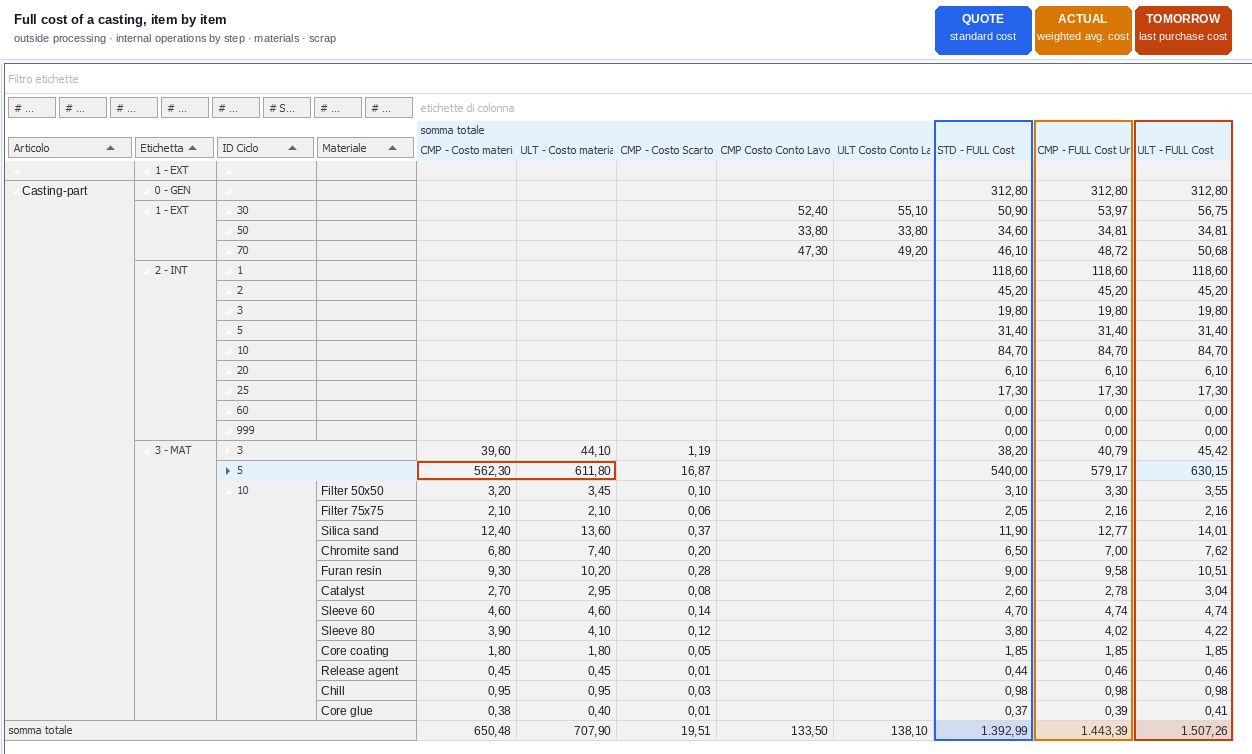
FOND/WISE calculates the full cost of every casting, breaking it down item by item, and compares it on three cost bases: standard cost (the quote), weighted average cost (the actual) and last purchase cost (tomorrow’s cost). It is the sheet shown at the top of this page.
How to read the sheet
- The rows break the item’s cost down by type: overheads, outside processing (subcontracted operations), internal operations and materials, each detailed by routing step and, for materials, by individual component: for example the metal in the pouring step, and sands, resins, filters and sleeves in the moulding step.
- The columns show material and outside-processing cost at weighted average cost and at last cost, the cost of scrap and the full cost in three versions: standard, weighted average and last.
- Scrap is costed and included in the full cost, so every good casting also carries the cost of the ones lost.
What the calculation runs on
- The delivery notes of a period: the real cost of what was delivered, to compare with the invoiced price.
- The order backlog: the cost of what has already been sold but not yet produced, calculated at current prices.
The data comes from master data and the shop floor: routings and standard times, alloy components and prices, subcontractor rates, scrap declared in the MES. No spreadsheet reconstruction.
Key features
Full cost by step
Internal and outside operations detailed by routing step.
Materials by component
Every material with its cost, its scrap and its share of the total.
Three cost bases
Standard, weighted average and last cost, side by side.
Outside processing
Subcontractor cost at average and last cost, by step.
Deliveries and backlog
Run on a period’s delivery notes or on open orders.
Basis for quotations
New quotes calculated on last cost, not on average parameters.
Costed scrap
The cost of lost pieces included in the full cost.
Worked example
Take the casting in the sheet above: example data, unit cost. The customer pays €1,650 per piece, a price fixed at the start of the year.
| Cost basis | Full cost | Margin | Margin % |
|---|---|---|---|
| Standard (the quote) | €1,392.99 | €257.01 | 15.6% |
| Weighted average (what it cost) | €1,443.39 | €206.61 | 12.5% |
| Last cost (what it will cost) | €1,507.26 | €142.74 | 8.7% |
The margin has fallen from the expected 15.6% to 8.7% at today’s prices, without any change in price or process. The sheet shows at once where:
- pouring materials (step 5), the largest item: from €562.30 at average cost to €611.80 at last cost, +8.8%: this is the metal price;
- moulding materials (step 10): silica sand and furan resin rise by almost 10%, while filters and sleeves are stable;
- subcontractor at step 30: from €52.40 to €55.10, a rate increase not yet passed on in the price.
If there are 120 pieces of this item in the backlog, the difference between standard and last cost is worth about €13,700 of margin already lost on accepted orders. That is the basis, documented item by item, for requesting a metal surcharge or revising the price list before production.
Frequently asked questions
What is the difference between weighted average cost and last cost?
Weighted average cost is the average of a period’s purchase prices, weighted by quantity: it tells you what the material consumed really cost. Last cost is the price of the most recent purchase: it tells you what it will cost to buy again. When last cost is much higher than average cost, future margins will be lower than past ones.
What is the standard cost of a casting?
It is the expected cost, calculated on reference quantities, times and prices defined by the foundry, often at quotation time. It serves as a benchmark: comparing it with average and last cost shows how far, and where, reality is moving away from the forecast.
Which cost should be used for quotations?
For a new quotation it is best to start from last cost, which reflects the prices at which you will have to buy. Weighted average cost is better suited to analysing the margins achieved in a past period.
Why calculate costs on the order backlog too?
Because the backlog contains prices already agreed and costs not yet incurred. Calculating it at last cost shows which orders are already loss-making or below the minimum margin, while there is still time to renegotiate, apply a metal surcharge or change priorities.
Why should scrap be included in the full cost?
Because scrapped castings have consumed metal, materials and operations, and that cost must be recovered from the good castings. A cost that excludes scrap is systematically lower than the real one.
Can last cost be misleading?
Yes, if the last purchase was unusual: a small lot, an urgent purchase or a price entered by mistake. That is exactly why it helps to see it next to average cost: a very large gap on a single item is the signal to check the data before drawing conclusions.